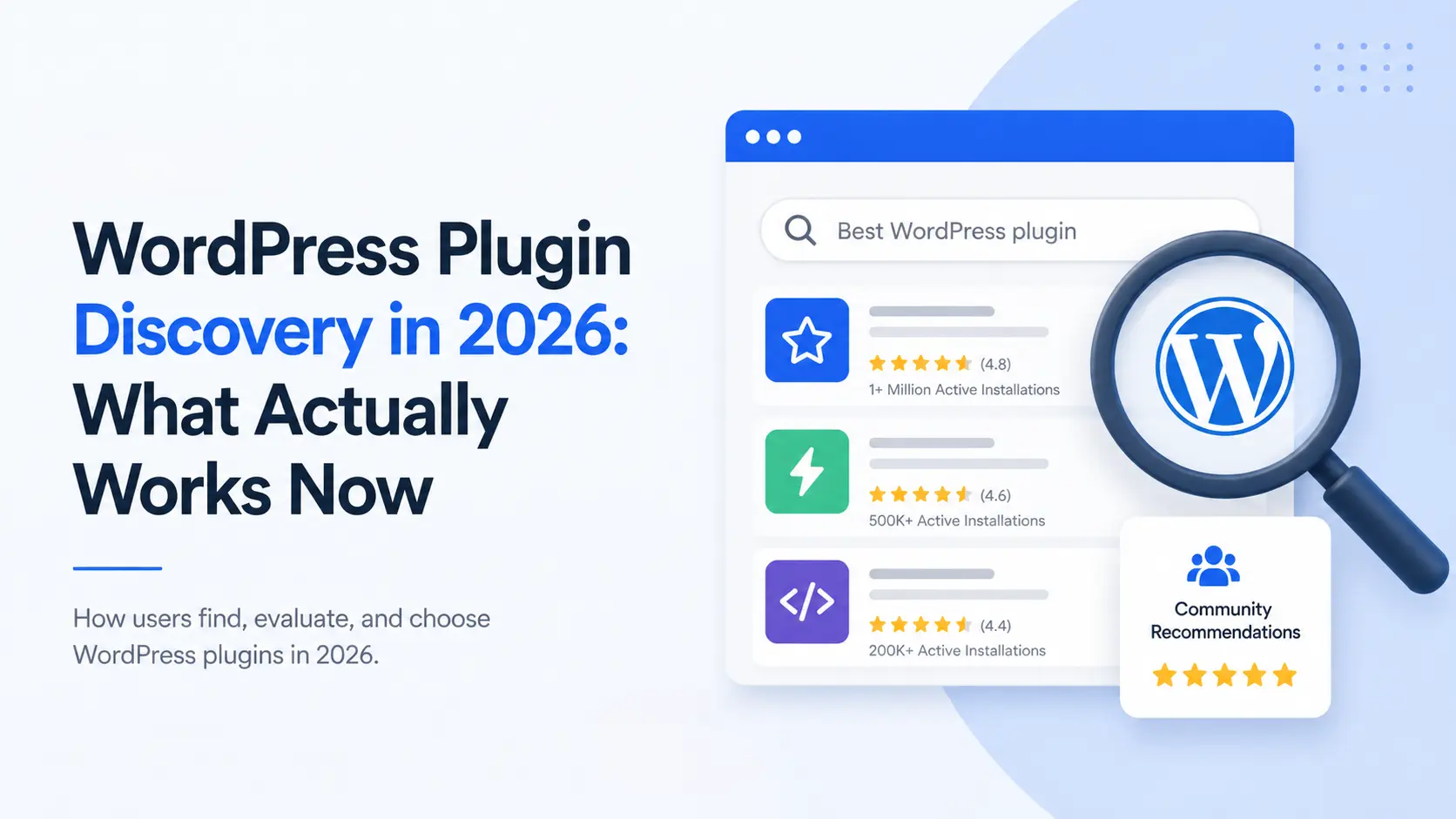
There are over 60,000 plugins sitting in the WordPress.org directory right now. Throw in premium plugins from CodeCanyon, Freemius powered shops, and independent developers selling on their own sites, and the number goes way higher.
WordPress runs 43% of all websites today, and honestly, that massive plugin ecosystem is a big reason people keep choosing it over other platforms.
But here’s the part nobody really talks about: actually finding the right plugin is a nightmare. Search the directory for “SEO” and you’ll get over 1,000 results staring back at you. Most of them have nearly identical descriptions, similar feature lists, and screenshots that all start to blur together.
So how do people actually decide?
We spend a lot of time watching how people discover and choose WordPress plugins. We look at surveys, community discussions, search trends, and our own experience running several client websites.
Here’s what we’re seeing shape WordPress plugin discovery in 2026.
1. WordPress.org Search Is Broken, and Everyone Knows It
Let’s just say it plainly: the WordPress plugin directory has a search problem. It ranks results using a “popularity” metric that blends install count with rating, which means the same established plugins sit at the top year after year while newer, genuinely better alternatives never get a chance to break through.
Try searching “form builder” and you’ll see the exact same names that topped the results back in 2019. Meanwhile, lighter, faster, more modern plugins that launched since then are buried on page four or five. The directory just doesn’t have the semantic search or intent classification that Google and the App Store figured out years ago.
What this means in practice: most plugin discovery doesn’t even start in the WordPress.org directory anymore. People search Google first, browse YouTube, scroll Reddit, or ask in Facebook groups. Basically anywhere except the official directory.
2. Google Is the Real Plugin Directory Now
This is probably the biggest shift in how plugin discovery has changed over the last few years. When someone needs a plugin, they don’t log into their WordPress admin and search from there. They open Google and type something like “best WordPress form builder plugin” or “WordPress caching plugin comparison.”
Blogs like WPBeginner, WPMU DEV, Kinsta, and yes, us here at NextAppFinder, have basically become the real plugin discovery layer. One well written comparison post can drive more installs to a plugin than its entire WordPress.org listing ever generates organically.
Just take WPBeginner. Their YouTube channel alone has over 800,000 subscribers, and their tutorial posts rank on page one for nearly every major plugin keyword out there. When Google becomes the directory, SEO becomes the storefront.
3. Social Proof Is the First Filter People Apply
According to CreativeMinds’ survey of 100 WordPress users, the number one factor in choosing a plugin wasn’t features or price. It was what other people said about it.
The first move most users make when evaluating a plugin is checking the star rating. Then they scroll through recent reviews, and not the glowing five star ones either. They go straight for the one to three star reviews to see what actually breaks. After that, they’ll often Google the plugin name plus “problems” or “conflicts” just to see what real users are complaining about.
Plugins sitting under 4.0 stars in the WordPress.org directory face an uphill climb. Not because low ratings hurt them algorithmically (they actually don’t, since the directory doesn’t penalize low ratings in search rankings), but because human buyers treat that star rating as a trust signal, whether it’s technically “fair” or not.
4. YouTube Tutorials Have Become the New Product Demos
Nobody really reads documentation anymore, let’s be honest. When someone wants to know if a plugin actually works, they head straight to YouTube and search “[plugin name] tutorial” or “[plugin name] review.”
A plugin with a solid, thorough setup video on YouTube tends to get installed more often than one without, even when the video less plugin technically has more features. People want to see the actual interface, watch someone click through the settings in real time, and judge for themselves whether it looks like a headache to set up or not.
This shift has pushed plugin developers to invest seriously in video content. The smart ones are partnering with YouTubers for review videos, building their own walkthroughs, and embedding video right on their marketing pages. A plugin with no face behind a demo video is a plugin most people just scroll right past.
5. Reddit and Facebook Groups Are the New Word of Mouth
Every single day, someone asks the same question in r/WordPress, r/WooCommerce, or one of a dozen Facebook groups. For example – “What’s the best plugin for mix and match bundles?” And the answers people get genuinely shape real purchasing decisions.
These communities work almost like a crowdsourced filter for plugins. When a plugin keeps getting recommended by different people across multiple threads over time, it builds a kind of organic credibility that no amount of paid marketing can really replicate.
Developers who show up in these communities and engage authentically, even when the honest answer isn’t “use my plugin,” end up building real discovery momentum over time. The ones who just spam their plugin link in every thread tend to get downvoted straight into oblivion.
6. Active Install Count Is Still the King Signal
Despite everything else on this list, nothing beats seeing “1+ million active installations” as a trust badge.
The WordPress.org directory prominently displays install counts right on every plugin card, and users absolutely treat that number as a proxy for quality. Put a plugin with 10,000 active installs next to one with 500,000, and most people will go with the bigger number every time, even if the smaller plugin is actually better built.
This creates a real chicken and egg problem for new plugins. You need installs to get visibility, but you need visibility to get installs in the first place. That’s exactly why just launching on WordPress.org isn’t enough anymore. You need the blog reviews, the YouTube videos, and the community engagement, all happening before the directory ever “discovers” you on its own.
7. Freemius and Third Party Marketplaces Changed the Game
The rise of Freemius as a distribution platform really changed how premium plugins get discovered. Instead of buying through CodeCanyon or some custom checkout page, users can now purchase and manage premium plugins directly from inside their WordPress admin dashboard.
This matters for discovery because Freemius powered plugins show up in the WordPress.org directory with a “lite” version, then upsell through the admin dashboard once someone’s already using it. That free version basically acts as a funnel: users install it, try it out, and upgrade if they end up liking it.
CodeCanyon used to be a major piece of this puzzle too, but that’s changed fast. Sales on the platform have dropped sharply since 2018, and as of early 2026 Envato stopped accepting new plugin authors altogether, so it’s no longer really an option for a new plugin trying to get discovered.
Direct sales sites and tools like Easy Digital Downloads have picked up the slack instead, especially for niche plugins solving problems the directory doesn’t handle well.
8. AI Assistants Are Becoming Plugin Recommenders
This one’s been picking up speed very fast. Users have started to ask ChatGPT, Gemini, and Perplexity questions like “What’s the best free cart abandonment plugin?” or “Recommend a lightweight caching plugin for my site.”
The AI obviously doesn’t have hands on experience using the plugin itself. It’s pulling recommendations from blog posts, reviews, forum threads, and documentation floating around online. Which means your plugin’s overall online presence across all those channels directly feeds into whatever the AI ends up recommending.
This blending of AI discovery with traditional SEO might be the most important long term shift on this whole list. Plugins with strong documentation, active community discussions, and solid coverage on trusted blogs tend to get recommended more often. The same content strategy that helps you rank on Google is now helping you rank inside ChatGPT too.
9. Users Will Pay, But the Free Version Has to Earn It First
The old assumption was that WordPress users are cheap. Turns out the data tells a different story. According to CreativeMinds’ survey, 49% of WordPress users are willing to pay over $60 for a good plugin. And it’s not just developers either. Site owners, bloggers, and business owners all showed a real willingness to invest in the right tool.
But here’s the catch: users almost never buy a premium plugin without trying the free version first. The typical discovery journey looks like free, then freemium, then paid. Skip the free tier entirely, and you’re skipping most of your potential market along with it.
56% of users say they most often go with free plugins, mixing in just a few premium ones here and there. Only 34% split their usage evenly between free and premium. The “free version as a discovery funnel” idea isn’t just a smart strategy. It’s genuinely how most plugin discovery works in practice.
10. The Last Updated Date Is a Dealbreaker
Out of all the signals users check when sizing up a plugin, the “Last Updated” date is one of the most decisive. A plugin that hasn’t been touched in over two years is basically non-existent to most users, no matter how many stars it’s racked up.
Think about it: WordPress itself pushes updates three to four times a year. PHP versions keep moving forward. Security standards keep evolving. A plugin that hasn’t been updated in 18 months is essentially a security risk waiting to happen, and users know this in 2026.
That gives a real edge to actively maintained plugins, even the smaller ones with fewer installs. A plugin updated two weeks ago with a “Tested up to 6.6” badge will win out over some five year old giant plugin that hasn’t been touched in ages. Freshness has genuinely become a trust signal strong enough to override raw popularity.
What This Means for Plugin Discovery Going Forward
Plugin discovery in 2026 has moved on from where it used to be. It’s no longer about getting featured on WordPress.org or climbing some popularity chart inside the directory. The real discovery is happening on Google, on YouTube, on Reddit, and increasingly, inside AI chat interfaces.
For users, the real challenge is filtering 60,000+ options down to the one that actually works for them. The signals worth paying attention to: active install count for momentum, last updated date for maintenance, rating depth (not just the overall score), YouTube tutorials to see if it’s actually usable, and community mentions from real people vouching for it.
For developers, the playbook is pretty clear at this point. Ship a free version that proves its worth, get coverage from trusted WordPress blogs, put together real YouTube walkthroughs, show up in communities without constantly selling, and keep the plugin updated religiously. That’s genuinely how plugins get found in 2026.
1 thought on “10 WordPress Plugin Discovery Trends We’re Seeing in 2026”