Black Friday is one of the biggest opportunities of the year to attract new customers, move more products, and bring back people who have been sitting on the fence. But if you’re running a WordPress business, selling digital products, or managing a WooCommerce store, there’s one question you need to answer before launching your campaign:
There is real scale behind the event: Shopify reported $14.6 billion in global merchant sales over Black Friday–Cyber Monday 2025, a 27% year-over-year increase. That is platform-wide data, not a promise that every store will grow by the same amount, but it shows why businesses prepare their offers well in advance.
How much should you discount without giving away more than you need to?
It’s tempting to advertise a massive 70% discount because competitors are doing it. You might even consider making every product cheaper just to keep up. But a bigger discount isn’t always a better deal for your business. It can reduce your profit, make customers question your regular pricing, and leave you with a lot of sales that don’t translate into sustainable revenue.
The smarter approach is to choose a discount strategy based on what you’re trying to achieve. Maybe you want more first-time customers, higher-value orders, annual subscriptions, or long-term customers who will renew next year.
Let’s look at the Black Friday pricing strategies that can help you achieve those goals without relying on blanket discounts.
Quick decision: Which Black Friday pricing strategy should you use?
| Your goal | Pricing strategy to consider | Why it works |
|---|---|---|
| Attract new customers | First-purchase discount | Gives people a reason to try your product |
| Increase average order value | Tiered discounts or bundles | Rewards customers for buying more |
| Generate early sales | Early-bird pricing | Gives customers a reason to purchase before Black Friday |
| Sell more of a specific product | Product-specific discounts | Concentrates your promotion on selected products |
| Increase annual subscriptions | Annual-plan incentives | Encourages a longer commitment |
| Reward loyal customers | VIP offers or early access | Gives existing customers a reason to engage |
| Protect profit margins | Value-added offers | Adds value without cutting the price as deeply |
You don’t need to use all these strategies in one campaign. Pick one primary goal, then choose the offer that supports it. A store trying to increase order value needs a different promotion from a plugin developer trying to acquire new customers.
1. Choose your discount percentage based on the goal
The first mistake many businesses make is choosing a discount percentage before deciding what they want to achieve.
Personally, I’d start with the numbers before designing the sale banner. In content and product marketing, it’s easy to get pulled toward the biggest headline discount because it looks compelling. But the offer only makes business sense if the additional conversions make up for the margin you give away.
A 20% discount might be enough to persuade an existing customer to upgrade. A new customer comparing five competing plugins might need a more compelling offer. Meanwhile, a product with a tight profit margin might not be able to support a deep discount at all.
Instead of copying competitors, start with three questions:
- What do I want this campaign to achieve?
- How much room do I have to discount?
- What offer would make the right customer take action?
For example, imagine you sell a WordPress plugin for $100 per year. You could offer 20% off and charge $80, or offer 40% off and charge $60.
The second offer looks more attractive, but you’re giving up an additional $20 per sale. If the smaller discount would have generated nearly the same number of purchases, the deeper discount may not be worth it.
Calculate the impact before choosing the discount
Suppose your product normally costs $100 and costs you $20 per sale in variable expenses. For simplicity, we’ll ignore other fixed business expenses.
| Pricing | Revenue per sale | Variable cost | Contribution per sale |
|---|---|---|---|
| Full price | $100 | $20 | $80 |
| 20% off | $80 | $20 | $60 |
| 40% off | $60 | $20 | $40 |
At full price, you keep $80 before fixed costs. With a 20% discount, that falls to $60. With a 40% discount, it falls to $40.
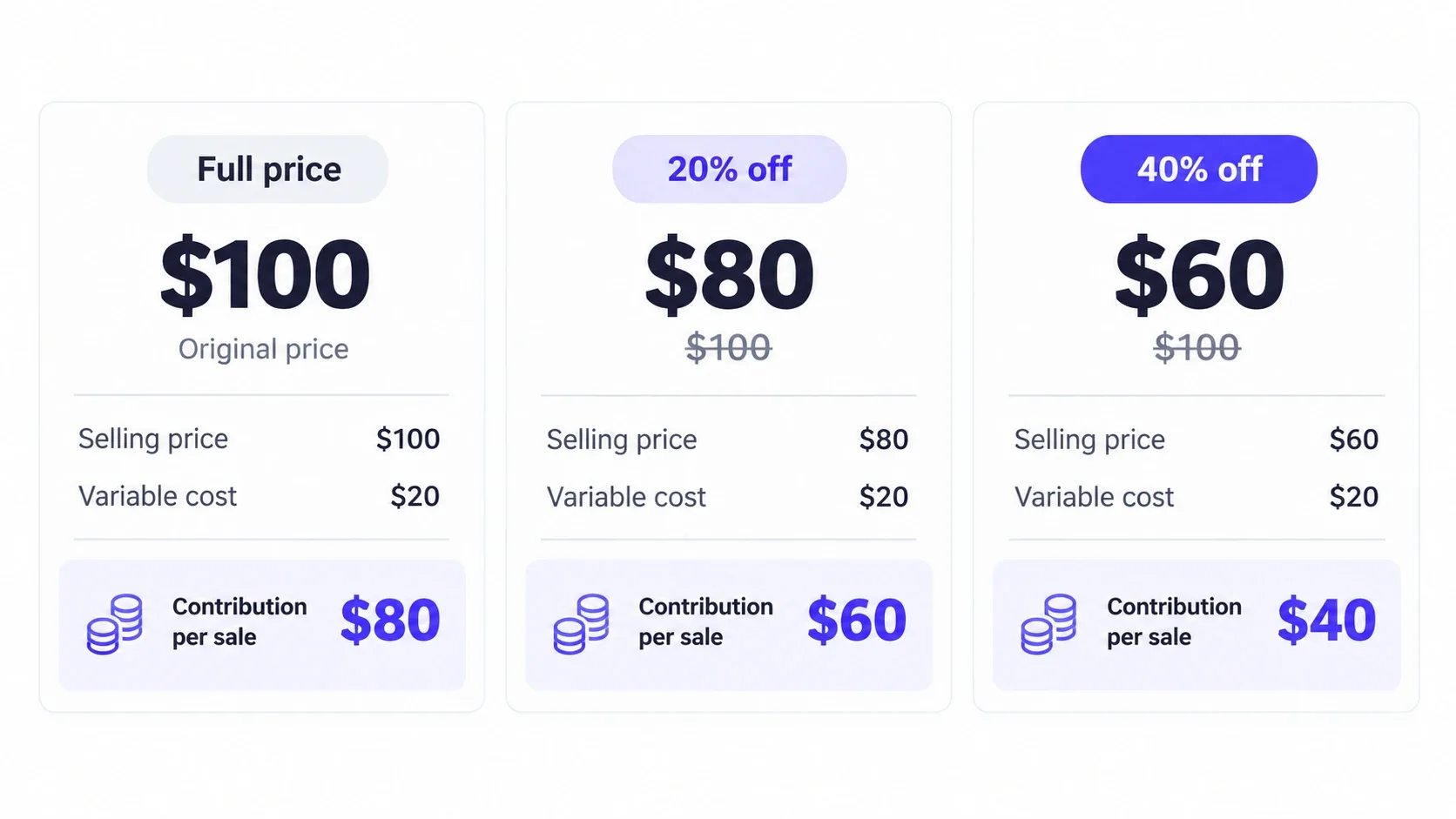
To generate the same total contribution as 100 full-price sales, you’d need approximately 134 sales at 20% off or 200 sales at 40% off.
That’s the part discount banners don’t show you.
The takeaway: Don’t choose your discount based on how impressive it looks. Choose it based on customer response, your costs, and the number of additional sales you realistically expect.
2. Use tiered discounts to encourage bigger purchases
A flat discount gives everyone the same deal regardless of how much they buy. Tiered pricing gives customers a better reward when they spend more or purchase more products.
For example, a WooCommerce store might offer:
- Spend $50 and save 10%.
- Spend $100 and save 15%.
- Spend $150 and save 20%.
The idea is simple: customers who are close to the next spending threshold have a reason to add another product to their cart.
For a WordPress product business, you could adapt this approach to bundles or license packages. A customer buying a single plugin might receive 20% off, while someone purchasing a bundle of several plugins receives a larger overall saving.
However, don’t make the thresholds arbitrary. Base them on your average order value, product prices, and margins. If customers usually spend $45, a $50 threshold might be achievable. A $200 threshold may be too high unless you’re selling higher-priced products.
Also, make sure the discount doesn’t apply in a way that undermines the offer. If a customer qualifies for a 20% discount on the entire order by adding one inexpensive item, calculate whether the extra purchase compensates for the discount on the existing cart.
For implementation, WooCommerce’s coupon management documentation explains how to configure percentage discounts, fixed-cart discounts, product restrictions, and minimum-spend requirements.
3. Bundle products instead of discounting everything
Bundles are particularly useful when you sell multiple related products.
Instead of cutting the price of every product individually, combine products that solve a related problem and offer them together at a lower total price.
For example, imagine a store sells three products:
- Product A: $50
- Product B: $40
- Product C: $30
The combined regular price is $120. A Black Friday bundle priced at $84 gives customers a 30% saving while encouraging them to purchase all three products.
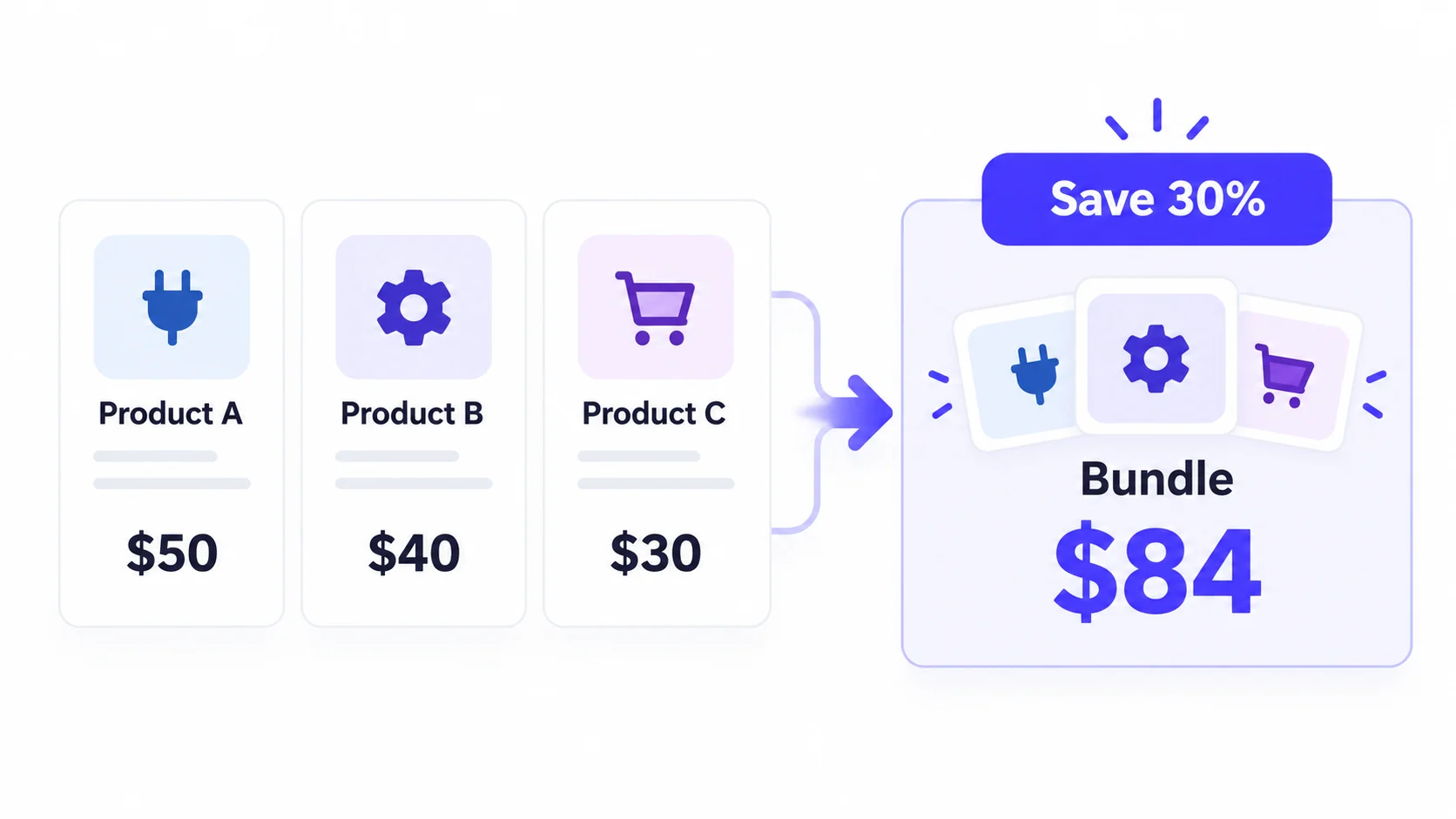
The advantage is that you’re selling a more complete solution rather than simply making one product cheaper. You may also introduce customers to products they wouldn’t have purchased individually.
My practical take: a bundle should feel like a shortcut to solving a problem, not a pile of products thrown together to justify a discount. For WordPress businesses, that means choosing tools that complement one another and explaining why a customer would benefit from the combination.
For WordPress plugin developers, this could mean bundling complementary tools, such as a page-building plugin, a form builder, and a popup tool. For WooCommerce stores, it could mean combining products that customers commonly purchase together.
Before launching a bundle, check three things:
- Compatibility: Do the products work well together?
- Perceived value: Does the combination solve a meaningful problem?
- Profitability: Does the bundle remain profitable after the discount?
Don’t bundle unrelated products simply to make the package look bigger. A smaller bundle with a clear purpose is often easier to sell than a collection of products customers don’t need. If you run a WooCommerce store, see our guide on how to create mix-and-match bundles in WooCommerce.
4. Offer early-bird discounts before Black Friday
You don’t have to wait until Black Friday itself to start generating sales.
An early-bird offer rewards customers who purchase before the main campaign begins. For example, you might offer 30% off during an early-access period and a different offer during Black Friday weekend.
This can help you generate sales earlier, reach customers who prefer to buy before the rush, and build momentum for your main promotion.
For WordPress businesses, early access can work particularly well for existing users, email subscribers, and customers who already understand the value of your product.
You could structure your campaign like this:
- Early access: Give subscribers the first opportunity to purchase.
- Black Friday: Promote your main public offer.
- Cyber Monday: Introduce a genuinely different bundle or final promotion if it makes business sense.
There’s no need to make every stage cheaper than the previous one. If early buyers receive a good offer, repeatedly undercutting it later can make them feel penalized for purchasing early.
Be transparent about the campaign dates and any differences between offers. If you advertise an early-bird discount as exclusive, make sure it actually provides a meaningful benefit.
5. Use annual-plan discounts to encourage longer commitments
If you sell WordPress plugins or SaaS products through recurring subscriptions, your pricing strategy should consider more than the first payment.
An annual plan can bring in more cash upfront and reduce the need to collect monthly payments. Customers may also appreciate paying once instead of managing another monthly subscription.
For example, suppose a product costs $15 per month or $150 per year.
- Monthly billing over 12 months: $180.
- Annual billing: $150.
- Annual-plan saving: $30, or approximately 16.7%.
During Black Friday, you could offer a further incentive on the annual plan. But calculate the effect on your future revenue before deciding how much to reduce the price.
For instance, if the annual price drops from $150 to $105, the customer receives a 30% discount. That’s a significant saving, but it also means you’ll collect $45 less from that customer during the first year.
For subscription products, I’d judge this offer by more than the launch-week sales total. Track renewals and retention after the discounted period, because a spike in first-year purchases doesn’t automatically mean the campaign created more valuable long-term customers.
For subscription products, distinguish between a discount on the first payment and a discount that continues at renewal. Make the terms clear on the offer page and at checkout.
WooCommerce Subscriptions supports different coupon behaviors, including discounts on recurring payments. Its subscription coupon documentation explains the distinction.
For plugin businesses, this matters because a large first-year discount can attract customers without necessarily producing the same long-term revenue as a smaller discount on a multi-year commitment. Track renewals and retention rather than judging the campaign only by its initial sales.
6. Use lifetime deals carefully
Lifetime deals are common in the WordPress ecosystem, particularly during Black Friday. Customers pay once and receive access under the seller’s stated lifetime-license terms rather than paying annually.
For buyers, the appeal is obvious: one payment instead of recurring subscription fees. For developers, a lifetime deal can generate upfront cash and introduce the product to new customers.
But there is a trade-off.
If you sell a plugin with a $100 annual license and offer a $199 lifetime license, a customer who would otherwise renew for several years may become less valuable over time. You still need to maintain the product, fix bugs, and provide whatever updates and support the license promises.
A simple break-even calculation can help.
Suppose your annual license costs $100 and your lifetime license costs $250. Ignoring future price changes and differences in customer behavior, the lifetime purchase equals 2.5 years of annual payments.
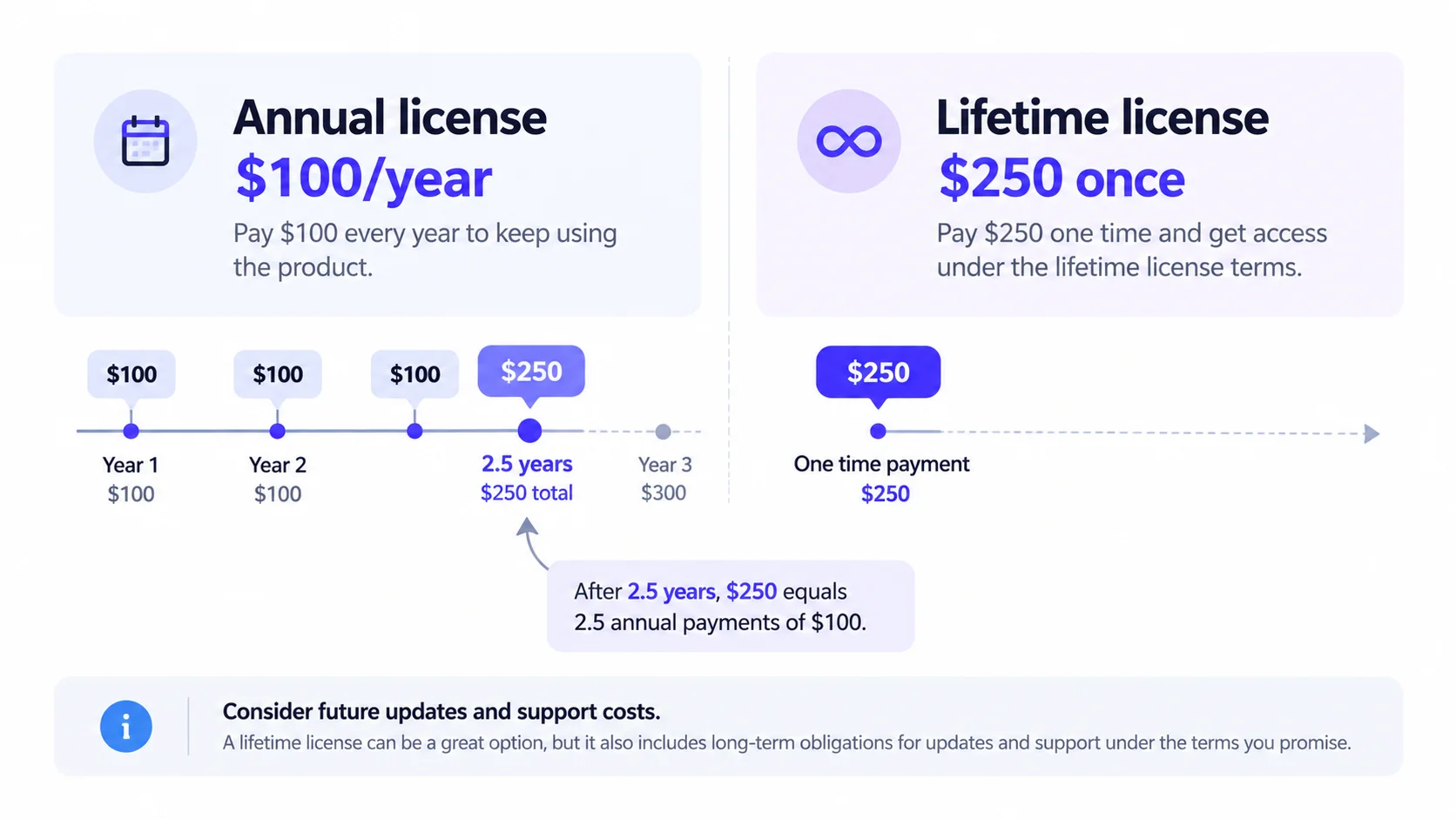
That doesn’t mean every customer would have renewed for 2.5 years. Some may cancel sooner, while others may remain customers much longer. Your decision should account for actual renewal and retention patterns.
Before launching a lifetime offer, decide:
From a product-business perspective, the important question isn’t just whether the one-time price looks attractive today. It’s whether that payment can support the updates, compatibility work, and support customers will reasonably expect over time. Treat the break-even calculation as a starting point, then compare it with your actual renewal and support data.
- Which features are included?
- How many websites can the license cover?
- Are updates and support included, and under what terms?
- Does the deal apply to existing customers or only new buyers?
- Can the product’s future maintenance costs be supported by the upfront payment?
Lifetime deals can be effective, but they shouldn’t be priced solely to produce an eye-catching headline.
7. Add value instead of cutting the price further
Sometimes the best Black Friday offer isn’t a bigger discount. It’s a more useful package.
Imagine a product already discounted by 25%. You could reduce the price by another 10%, or you could include a bonus that customers would genuinely value.
Depending on your business, that bonus could be:
- A premium template or starter kit.
- A setup guide or implementation checklist.
- An onboarding session.
- A useful complementary product.
- Additional training resources.
For a WordPress plugin, a bonus template pack might have a low delivery cost but make the product more attractive. For a WooCommerce store, a gift with purchase could encourage customers to choose your store without lowering the price of every item.
The important distinction is between perceived value and actual cost. A bonus isn’t automatically profitable just because it sounds valuable. Consider the time required to deliver it and any additional support it may generate.
This strategy is especially useful when you want to protect your regular pricing or avoid training customers to wait for increasingly large discounts. If you’re choosing tools for your store, our roundup of free AI tools for WooCommerce may also help you identify useful additions to your workflow.
8. Create different offers for different customer groups
Not every customer needs the same incentive.
A new visitor might need a strong reason to try your product. An existing customer might respond better to an upgrade offer, an exclusive bundle, or early access.
Consider separating your campaign into a few practical segments:
| Customer group | Offer idea | Primary goal |
|---|---|---|
| New customers | First-purchase discount | Acquire customers |
| Existing customers | Upgrade or bundle offer | Increase customer value |
| Loyal customers | Early access or bonus | Reward loyalty |
| Inactive customers | Targeted comeback offer | Encourage reactivation |
| Agency customers | Multi-site or bundle pricing | Support larger purchases |
You don’t need a complicated personalization system to begin. Even separate offers for new and existing customers can make your campaign more relevant.
For example, giving every existing customer the deepest discount may unnecessarily reduce revenue from people who were already likely to buy. A smaller upgrade incentive or early-access benefit may be enough.
Keep eligibility rules clear, avoid sending conflicting offers to the same person, and test your checkout to ensure the intended discount is applied.
9. Use limited-time offers without damaging trust
Flash sales and countdown timers can help customers make a decision, especially when a promotion has a genuine deadline.
But urgency only works sustainably when customers trust it.
If your banner says the offer ends tonight and the same discount appears again tomorrow, people may learn to ignore your deadlines. Repeatedly extending a supposedly final offer can also frustrate customers who purchased earlier.
A better approach is to establish a clear promotion schedule:
- Announce the offer and its start and end dates.
- Explain whether early access differs from the public sale.
- Use countdown timers only when they reflect the actual deadline.
- Remove expired codes and update sale banners when the promotion ends.
You can also limit a promotion by product, customer group, or redemption count when the restriction is genuine and technically enforced.
For WooCommerce stores, coupon expiry dates, product restrictions, and usage limits can help manage these rules. See the official WooCommerce coupon guide for the available settings.
10. Test your discounts before the campaign goes live
A pricing strategy can look perfect in a spreadsheet and still fail at checkout.
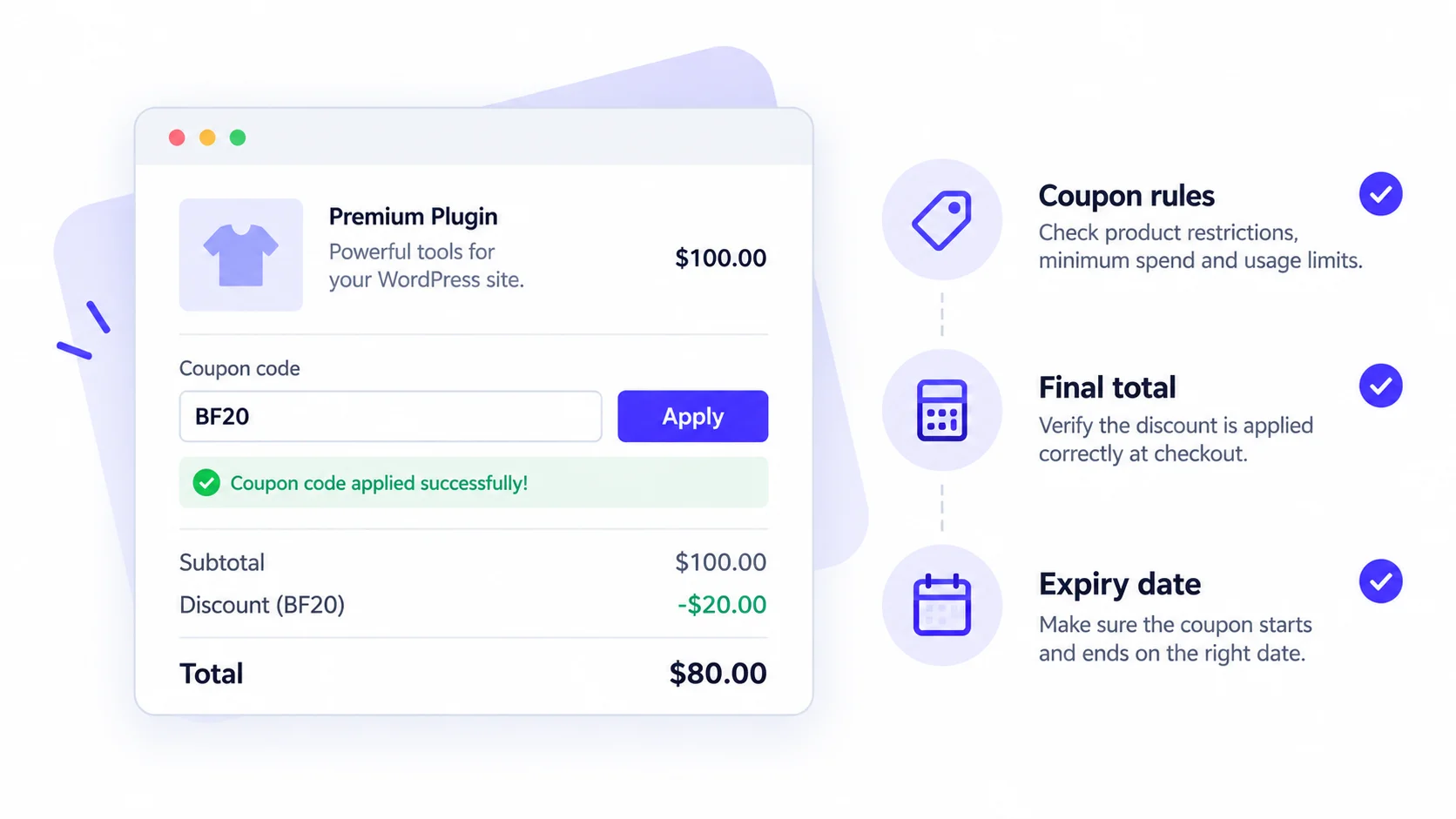
A coupon might apply to the wrong products. Two discounts might stack unexpectedly. A bundle might calculate its price incorrectly, or a scheduled promotion might start at the wrong time.
Before launch, test the entire purchase journey. This is worth treating as a required launch task, not a last-minute extra: a correctly advertised discount is useless if the coupon applies to the wrong products or the final checkout total surprises customers.
- Apply every coupon to an eligible product.
- Check that excluded products remain excluded.
- Test minimum-spend requirements and usage limits.
- Verify whether discounts apply before tax and how shipping is calculated.
- Check whether coupons can combine with sale prices or other offers.
- Test the promotion on mobile and desktop.
- Confirm that the start and end dates match the advertised schedule.
- Review the final order total before payment.
WooCommerce documents its coupon types, restrictions, and limits in its coupon management guide. The settings available in your store may also depend on installed extensions.
Don’t wait until Black Friday morning to test your offer. Run the checks in advance, then repeat a quick purchase test after any last-minute changes.
11. Measure profit, not just sales
A campaign that generates record revenue isn’t necessarily a successful campaign. For context, Adobe Analytics reported that US online spending reached $11.8 billion on Black Friday 2025, up 9.1% year over year. That headline describes the overall market; it doesn’t tell an individual store whether its own discount was profitable.
To understand whether your pricing strategy worked, track metrics that connect the offer to business results.
Start with these five:
- Conversion rate: What percentage of visitors purchased?
- Average order value: Did customers spend more per order?
- Contribution per order: How much remained after variable costs?
- New-customer acquisition: Did the campaign bring in new buyers at an acceptable cost?
- Renewal and retention: For subscription products, did discounted customers continue paying later?
Compare results with a relevant baseline, such as a normal sales period or a previous campaign. Account for differences in traffic, seasonality, and advertising spend before attributing every change to the discount.
Also distinguish between revenue and profit. A bundle might generate a higher average order value but lower contribution per order. A deeper discount might increase conversions without generating enough extra sales to compensate for the lower price.
For subscription businesses, continue monitoring customers after the campaign ends. First-month sales won’t tell you whether the promotion created lasting customer relationships.
What real WordPress companies can teach us about BFCM pricing
The best Black Friday and Cyber Monday offers from WordPress companies aren’t all built around the same discount percentage. Looking at the 2025 campaigns from Elementor, Divi, WPX, and Kinsta reveals four different approaches: vary discounts by product, add bonuses to bundles, reward longer commitments, and create different offers for different customer groups. These are examples of past campaigns, not current 2026 offers; the companies may change their terms for the next sale.
| Company and 2025 offer | Pricing approach | What you can learn |
|---|---|---|
| Elementor: Editor plans discounted by 6%–20%, hosting plans by up to 50%, and add-ons by up to 65%. Multi-year plans could receive additional discounts. | Different discounts for different products and plan tiers. | Don’t automatically apply one headline discount to your entire catalog. Choose a discount based on the product, target buyer, and value you want the offer to communicate. |
| Divi (Elegant Themes): 80% off Divi Pro and the Divi Pro Bundle, a free Divi Marketplace product with purchases, and marketplace bundles promoted at 70% off. Existing subscriptions could also be repackaged to lock in the promotional discount. | Pair a deep discount with a bonus, bundle options, and an offer for existing customers. | The headline price is only one part of the offer. A relevant bonus can increase perceived value, while an upgrade or rebundling option gives existing customers a reason to act too. |
| WPX: New customers could get up to 85% off monthly plans. Prepaid plans ranged from four free months on a one-year term to 24 free months on a five-year term. | Increase the reward as the customer commits for longer. | Free months can make a longer commitment easier to compare than a single discount percentage. But explain the upfront payment, regular renewal price, and eligibility clearly—especially when promotional pricing applies only to new customers. |
| Kinsta: The 2025 campaign offered up to 50% off for new customers, with monthly and annual billing options. Agencies could instead choose an Agency Launchpad offer with $10,000 in hosting credits; the offers could not be combined. | Give different customer segments different kinds of value. | A smaller, targeted alternative may be more useful to an agency than a general percentage discount. Consider whether freelancers, agencies, and individual site owners need different incentives. |
There are a few practical lessons across these campaigns. First, discount depth can vary by product: Elementor’s 2025 offer ranged from modest Editor-plan savings to deeper discounts on selected add-ons and hosting plans. Second, Divi used bonuses and bundles to add value beyond the percentage off. Third, WPX tied larger free-month rewards to longer prepaid terms. Finally, Kinsta gave agencies an alternative to its regular discount rather than assuming the same offer would suit every buyer.
These examples show how the offers were structured; they don’t prove that any one strategy produced the highest profit. Before copying one, calculate your margins, consider future renewals and support costs, define which customers qualify, and make the final price and renewal terms easy to understand.
Source note: The examples above refer to the companies’ published 2025 campaigns. Promotional dates have passed, and pricing and eligibility may change in future BFCM events.
Black Friday pricing strategy checklist
Before publishing your offer, run through this checklist:
- Define the primary goal of the campaign.
- Calculate your minimum acceptable selling price.
- Estimate the effect of each discount on contribution per order.
- Choose between a flat discount, tiered offer, bundle, annual-plan incentive, or value-added promotion.
- Check the effect on existing customers and future renewals.
- Write clear eligibility, expiry, and license terms.
- Test coupon restrictions, discount stacking, taxes, and shipping.
- Check the offer on mobile and desktop.
- Prepare tracking for conversions, average order value, and profit.
- Review the results after the campaign and document what to improve next year.
Frequently asked questions
What is the best discount percentage for Black Friday?
There isn’t one discount percentage that works for every business. Your ideal offer depends on your costs, margins, regular pricing, competitors, and campaign goal. Calculate the financial impact before deciding how much to discount.
Should I offer a flat discount or a tiered discount?
A flat discount is simple to understand and easy to promote. A tiered discount can encourage customers to spend more, but it must be structured carefully so that the additional spending compensates for the discount. Choose the option that best supports your goal.
Are lifetime deals a good Black Friday strategy for WordPress plugins?
They can be, particularly when upfront cash and customer acquisition are priorities. However, lifetime licenses create long-term obligations under the terms you promise. Consider future maintenance costs, support requirements, renewal revenue you may give up, and the license limits before setting the price.
How early should I launch my Black Friday offer?
Plan the pricing and technical setup several weeks ahead so you have time to test everything. You can then choose an early-access period, a main Black Friday promotion, and an optional Cyber Monday offer. Make sure customers understand the dates and differences between each stage.
How can I offer a discount without losing money?
Calculate the amount remaining after variable costs at each proposed price. Then estimate how many additional sales you would need to compensate for the reduced contribution per order. If a deeper discount requires an unrealistic increase in sales, consider a bundle, a targeted promotion, or a value-added bonus instead.
Summing Up
Black Friday pricing isn’t about offering the biggest discount in your industry. It’s about creating an offer that makes sense for your customers and your business.
Start with a clear goal. Use bundles or tiered discounts when you want to increase order value, annual-plan incentives when you want longer commitments, and value-added offers when you need to protect your pricing. If you’re considering a lifetime deal, calculate the long-term trade-off before committing.
Most importantly, measure what happens after the discount is applied. More sales are useful, but profitable sales and customers who stick around are what make a Black Friday campaign worth repeating.
2 thoughts on “WordPress Black Friday Discount and Pricing Strategies”